
Aquafab: how a Ballarat-made cocktail foam ended up on Disney cruise ships
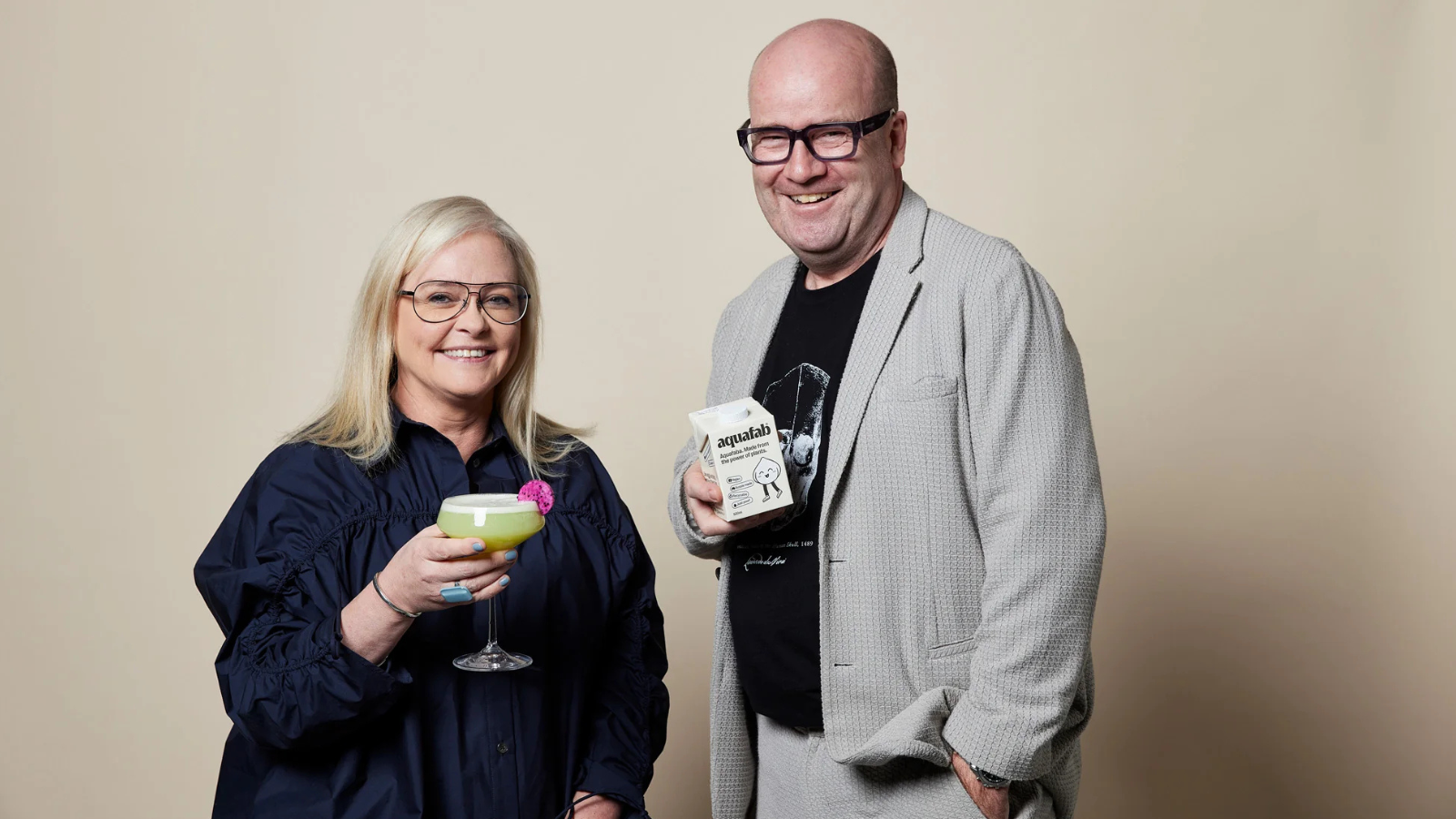

Most great hospitality products start with a frustration, not a formula. Aquafab started with both - and with two founders who knew exactly how much quiet chaos sits behind a beautifully foamed cocktail.
Rebecca Grey and Danny Kane built Aquafab to fix a problem bartenders had simply learned to live with. For decades, the silky foam on a whisky sour or a pisco sour has come from one of two awkward sources: raw egg white, with its spoilage risk and food-safety headaches, or chickpea brine decanted from a tin, with its waste and inconsistency. Neither was designed for a busy bar, and both quietly cost venues money on every shift.
Aquafab is the alternative the industry didn't know it was allowed to want: a ready-to-pour, 100% plant-based cocktail foamer, engineered specifically for hospitality and made in Ballarat from Victorian-grown crops. It pours like a mixer, behaves like egg white, and tastes of nothing - which is exactly the point. No raw eggs, no leftover yolks, no preservatives, no flavour interference. Just consistent foam, every time, from any staff member, on any night of the week.
A product built for the pass, not the pantry
What sets Aquafab apart from home-kitchen substitutes is that it was designed for real-world service from the start. Grey has been blunt about the pressure modern bars face - rotating staff, tight margins, and an expectation of fast, faultless drinks. A foamer anyone can use the same way, that stores simply and doesn't spoil mid-shift, isn't a luxury in that environment. It's infrastructure.
That framing has paid off. Since launching commercially in October 2024, Aquafab has gone from a single Instagram post to a national fixture in barely a year. It is now used in more than 800 venues across Australia and has helped pour over one million cocktails - across the country's best cocktail bars, but also RSLs, pubs, nightclubs, restaurants, cafes and five-star hotels.
The wholesale footprint grew just as fast. Aquafab is distributed through Paramount Liquor, ALM and ILG, with a national contract with Hyatt, a foothold in Crown venues, and a tender win across the 400-plus venues in the ALH group. You will find it behind the bar at Hilton, Sofitel, Crystalbrook and Solotel sites - accounts that do not change their service standards on a whim.
The awards followed the adoption. Aquafab was named a Rising Star by Food & Drink Business, took out Best Ingredient at the 2025 Hive Awards, won Best New Product at the 2025 Paramount Awards, and picked up Most Innovative Product at F&B@Sea 2025 in Miami.
The cruise industry doesn't adopt products lightly
That Miami win opened the door to Aquafab's most striking validation yet. The global cruise sector has historically restricted raw-egg cocktails on its vessels - at the scale a ship operates, raw egg white was simply considered too risky. As Kane puts it, the cruise industry does not adopt products lightly.
Aquafab changed the maths. A shelf-stable, plant-based foam with no food-safety baggage is exactly the kind of solution a ship can standardise across thousands of drinks a day. The result: Aquafab is now served by some of the biggest names on the water - Princess, Disney, Holland, Silversea, Crystal and Seabourn - and recently shipped its first export container to the United States, with roughly 19,000 units bound for cruise galleys.
For an Australian product made from a humble Victorian legume, landing on Disney and Princess ships is more than a nice headline. It is proof that Aquafab is not a local novelty but a category - and right now, a category with no direct competitor at scale.
Why Aquafab turned to the crowd
With a $30 billion global cocktail market in front of them and genuine pull from international distributors, Grey and Kane faced the classic scaling problem: real demand moving faster than working capital. Rather than hand the next chapter solely to institutional money, they opened the round to the people who had built the brand - the bartenders, operators and customers who had championed Aquafab one shaken drink at a time.
The Birchal raise, with a minimum investment of just $250, closed at $615,717 from 308 investors. That capital is earmarked for the things that turn momentum into market position: accelerating marketing, expanding international distribution into the US and UK, and building the working capital needed to keep up with export demand. A move into retail - putting Aquafab on liquor-store shelves alongside its hospitality presence - sits further down the roadmap.
What this success really says
Aquafab's story is a useful reminder of what crowdfunding does best. This was not a company chasing a valuation in search of a product. It was a product solving a daily, tangible problem, with the receipts to prove it - venues, volumes, contracts and container ships - inviting its own community to own a piece of the upside.
The founders built Aquafab for the person on the pass, working at speed with whatever crew turned up that night. It turns out that is also a pretty good blueprint for a business: solve the unglamorous problem properly, let the people closest to it spread the word, and the bigger doors - even the ones on cruise ships - start to open on their own.
You can explore Aquafab's profile on Birchal.
This article is general information only and is not financial advice or an offer of securities. Past campaign performance is not indicative of future results. Investing in early-stage companies involves significant risk, including the loss of your investment. Always read the relevant CSF offer document and the general CSF risk warning before investing.